So, Mad Society from the L.A. environs was Cathy Sample, bass, Aaron Glascock, drums, Louie Metz and Mark Vachon on guits and lead singer Steven Metz. They were a fairly standard though not at all bad punk-leaning-hardcore socal band, with one stand-out gimmick - lead singer Steven Metz was all of 9 or 10 years old. That's him on the front cover of the EP in Adam Ant regalia (I confess to being disappointed as I originally hoped the look was more Lord of the Flies). They apparently had a pretty good rep in their time. Their one EP had a dedication to Norton Wisdom, Tom Waits, Jello Biafra, Brendan Mullen and Rodney Bingenheimer. How cool is that?
Louis Metz was later in the band Spoon, Mark Vachon was in the re-united Dickies, and Cathy Sample got a writing credit on a Leaving Trains album. L'il Steven Metz became a yoga teacher, with Penelope Cruz and Rene Zellweger as clients!
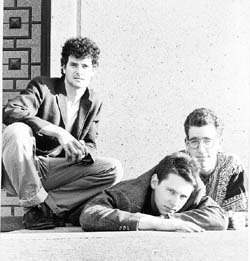
100 Flowers started off in 1978 as The Urinals, performing as a parody punk band at their UCLA dorm talent show. Apparently they went over big, cuz they kept on going, eventually touring and sharing stages with acts like the Go-Go's and Black Flag. Membership was:John Talley-Jones (also of
17 Pygmies,
Radwaste, and Vena Cava)
Kevin Barrett (also of God and State and Project 197),
and Kjehl Johansen (also of Trotsky Icepick).
As their music matured, they renamed themselves 100 Flowers, name inspired the Maoist "Hundred Flowers" campaign. They called it quits in 1983, then reformed (as The Uringals) in 1996, eventually releasing a new album. For a brief time they were known as The Chairs of Perception, but as of now remain active as The Urinals. Trouser Press described them fairly accurately as: arty, poetic music that is kinetic in spite of
occasional murkiness ... owes a mild debt to the Fall,
although its more melodic guitar sound is all-American.
Dispensing with such concepts as verses and choruses, the
trio favors subterranean funk grooves and drones; the
effect is impressive if limited, and wears thin over the
record's course ... this is how
R.E.M. might have sounded as a punk band. The Minutemen covered the Urinals song "Ack Ack Ack Ack Ack" on their final album, Three-Way Tie (For Last). Official Site (very nice!)
... another LA hardcore outfit (sometimes known as LA's Wasted Youth) very much in the standard mode. The members were Chett Lehrer (guitar, brother of Lucky Lehrer of the Circle Jerks), Jeff Long (bass), Allen Stiritz (drums), and Danny Spira (vocals). Danny Spira was later replaced by Jeff Dahlgren. They knocked out a 14 minute long LP in 1981, then fell silent until returning with an EP in 86 and then evolved into a thrash metal band (though still pretty punky) at decade's end. They toured a fair share, apparently successfully. Members went on to perform in Savage Republic; Joey Castillo became a drummer for Danzig and later Queens of the Stone Age; while Dave Kushner, who played guitar on their final Black Daze, went on to become a member of Velvet Revolver. Footage of the original lineup (1981-1983) can be seen in the film "Slog Movie", a film documenting the Orange County punk scene in Los Angeles at the time. The guitarist of Guns N' Roses, Slash, wears a Wasted Youth's t-shirt in the Live At The Ritz concert of 1988 transmitted by MTV. Thanks to Wikipedia from which I stole much of this info. Discography
Without a doubt, probably the most important figure in this particular story. The Flag, aside from simply being one of the premiere American "punk" bands, blazed trails all over the place: the music, the business, the culture and the country. They were the brainchild of Greg Ginn, an electronics geek (Ginn ran a surplus ham radio business for years, called Solid State Tuners, aka SST) and Deadhead who played guitar and wrote songs as a hobby. Inspired by Television, The Ramones, et al, Ginn started his own band, Panic, in Hermosa Beach, CA in 1976. He went through several members before scoring with singer Keith Morris. Over the next year, Chuck Dukowski, then playing bass in a similarly-minded band called Wurm, would join up. By the end of `77, they were up and gigging. Come `78, upon finding out there was already a Panic out there, they changed the name to Black Flag at the suggestion of Raymond Pettibon - early bassist and Flag, SST, and general SoCal punk artist extraordinaire. Pettibon also came up with the famous "bars" logo, which the band and cohorts soon started graffiti-ing the town with. It got them attention - not necessarily the right kind. Like the Sex Pistols, the Flag found themselves on the wrong side of the law. Associated in the eyes of the media with violence and "anti-parent" attitudes (whatever that was), they were harassed endlessly by the police, who beat up fans, and band members, with impunity. They later found themselves in legal hangups with the record label they'd contracted with to distribute their seminal first LP, Damaged. Ginn and Dukowski both did several days in jail on a contempt of court charge. The Flag were one of the pioneers of DIY, by necessity. Having a tough time getting gigs (LA's legendary Masque didn't want them - too suburban), they wrangled up their own gigs and venues anywhere they could find them, promoted them with Pettibon's now-legendary posters. When they ran out of halls that would book them in their hometown, they started cold-calling other punk bands to find out where they could gig in their town. Soon they were crossing the country, building a word-of-mouth-and-phone (no internet, guys) network of clubs, labels, studios and record stores that would prove fertile ground for nearly every band you'll find on this blog for the rest of the decade. Unable to get a label to release their records, they just found a pressing plant and started their own label - SST. SST would go on to release albums by scores of important underground artists in the 80's and beyond. By `81, still hounded by the cops, the Flag had burned through Keith Morris and Ron Reyes and was now burning through Dez Cadena, who was burning through his tonsils. So they pulled in D.C. fan and SOA lead singer Henry Garfield, soon to become Henry Rollins, to take the mike. Its then that the band really begins to take shape. While Morris/Reyes/Cadena were steeped in Rotten, Rollins had his own, deep-throated roar. He was also, along with Dukowski, loaded with charisma, and a natural front man. They cut that first long-player and released it in late `81. It even got them attention overseas, leading to a European tour. The lawsuit dealt them a blow. For the next three years, they were forbidden to release recordings as Black Flag - instead they popped out the documentary LP Everything Went Black, with a sticker over their name and logo. They toured and played their asses off. It was in `83 that local music rag BAM put them on the cover, and reading that interview at 17 was one of the defining moments of my musical evolution. A band this smart, this committed and this original just couldn't be ignored. That's when I really plugged in to American punk. The band evolved a lot on those years, shedding drummers, and eventually Dukowski. Their music evolved too, owing less to the thrash-y, three-chord beatdowns of their earlier days, and moving more into pounding, sometimes dirge-y (Rollins was a big Black Sabbath fan), overpowering rock, and wild, free-jazz instros (Ginn's wiggly guitar flip-outs). They recorded long tracks, jammed onstage, and grew their hair long. The Flag was unwillingly to be hemmed in by anyone's idea of what a punk rock band should sound, or look, like.
After the lawsuit, they flooded the market with albums. They were a mixed bag - powerful rockers side-by-side with tiresome dirges, experiments that didn't usually come off, and sometimes just plain embarassing metal duds. It was as a live band that their legend was made now - the band roaring away while Rollins (insert predatory animal-type synonym here - stalked, prowled, etc - you know you want to) the stage in his little black bike shorts, showing off his tats and his manly physique, baiting an audience who gladly took him up on it. A mistake? Rollins ended up getting burned, gashed, slashed and bruised - so did audience members - Rollins beating the crap out of some over-zealous challenger became a part of the ritual of a Flag show. Maybe it was what he and they wanted. By `86, the whole thing was getting long in the tooth. Rollins and Ginn could barely stand each other. Ginn, more interested in his instro bands anyway, pulled the plug. Rollins, now an underground star in his own right, went solo. Rollins is of course a minor celebrity now - band leader, TV host, spoken-word artiste, journalist, etc. Ginn did how own thing and now has reignited the Flag with its usual revolving-door of old-and-new cohorts. Morris, Dukowski, Stevenson, Cadena, and Egerton have toured as Flag. In tried-and-true fashion, that led to another court battle. Damagedis the classic - the best American hardcore album, period. The cream of the earlier stuff is on The First Four Yearsand Everything Went Black(which also features a 17+ minute medley of priceless radio spots for Flag gigs). The later albums are an acquired taste (I don't like `em much) - the best tracks are best heard onLive `84and Who's Got the 10 1/2?. The bootleg Complete 1982 Demos is also well worth a listen. You really needed to see the Flag to get what they were about. There are several semi- and un-official videos out there. There's a whole list on the Mighty Black Flag site. The official Flag site is here. Quite a bit's been written about them. Michael Azerrad's Our Band Could Be Your Lifegives a nice overview, and American Hardcore by Steven Blush by puts them in context. Stevie Chick's Spray Paint the Walls is an impressive full bio, and Rollins' own Get in the Van tells the whole story of relentless touring with a controversial, groundbreaking American punk band in gruesome detail.

 So, Mad Society from the L.A. environs was Cathy Sample, bass, Aaron Glascock, drums, Louie Metz and Mark Vachon on guits and lead singer Steven Metz. They were a fairly standard though not at all bad punk-leaning-hardcore socal band, with one stand-out gimmick - lead singer Steven Metz was all of 9 or 10 years old. That's him on the front cover of the EP in Adam Ant regalia (I confess to being disappointed as I originally hoped the look was more Lord of the Flies). They apparently had a pretty good rep in their time.